How nicotine works in disposable vapes like Geek Bar

How nicotine works in disposable vapes like Geek Bar
Most vape users assume nicotine works the same way regardless of the device they pick up. That assumption is wrong, and it matters more than you might think. Disposable vapes like Geek Bar use a specific nicotine formulation and delivery system that sets them apart from traditional cigarettes, refillable pods, and older box mods. Understanding how that system works gives you real control over your experience, your consumption habits, and your long-term goals as a vaper.
Table of Contents
- How nicotine works in disposable vapes
- Nicotine strength, speed, and user experience
- Risks, edge cases, and zero-nicotine options
- Vaping for harm reduction and the debate on addiction
- An expert perspective: What most vape users miss about nicotine in disposables
- Explore disposable vapes for your needs
- Frequently asked questions
Key Takeaways
| Point | Details |
|---|---|
| Nicotine salts explained | Disposable vapes use nicotine salts for higher concentration and smoother hits than traditional vape juice. |
| Faster nicotine delivery | Disposable vapes absorb nicotine more quickly, offering a faster hit compared to cigarettes and pod systems. |
| Risks of overuse | Smooth, high-nicotine disposables can increase addiction risk, so mindful consumption is essential. |
| Harm reduction debate | Disposables may help adults switch from cigarettes, but high nicotine and appeal raise youth concerns. |
| Explore safe options | Cloud District offers a range of disposables to suit your nicotine preferences responsibly. |
How nicotine works in disposable vapes
To understand why disposables feel different, you need to understand what’s actually inside them and how it reaches your bloodstream.
Most disposable vapes, including Geek Bar, use nicotine salts rather than freebase nicotine. Freebase nicotine is the standard form found in older e-liquids and traditional cigarettes. It’s chemically active and produces a harsh throat hit at higher concentrations, which limits how much manufacturers can realistically pack into a formula. Nicotine salts solve that problem. By combining nicotine with an organic acid (most commonly benzoic acid), the formula becomes more stable and far smoother to inhale. As nicotine salt formulations show, this enables concentrations of 20 to 50mg/mL with a smoother throat hit and faster absorption compared to freebase nicotine.

That’s a significant concentration range. For context, many older freebase e-liquids topped out at 3 to 6mg/mL before the throat hit became too uncomfortable to use consistently. Nicotine salts changed the ceiling entirely.
Beyond the formulation, delivery mechanics also play a major role. Our vape guides cover this in more depth, but the short version is this: disposable vapes heat e-liquid into an aerosol with particle sizes in the 1 to 3 micrometer range. That particle size is critical. Smaller particles penetrate deeper into the lungs, which speeds up absorption. According to nicotine delivery research, pod and disposable systems produce tight aerosol particle bands that optimize transfer to the bloodstream more efficiently than earlier open-tank systems.
Here’s a quick breakdown of how the two nicotine types compare inside disposable systems:
| Feature | Freebase nicotine | Nicotine salts |
|---|---|---|
| Throat hit at high concentration | Harsh | Smooth |
| Typical concentration range | 3 to 6mg/mL | 20 to 50mg/mL |
| Absorption speed | Moderate | Fast |
| pH level | Higher (alkaline) | Lower (acidic) |
| Common in disposables | Rare | Standard |
Other factors that shape your experience include:
- Puff duration: Longer puffs increase the volume of aerosol and nicotine delivered per draw
- Coil temperature: Higher temperatures vaporize more e-liquid per puff, affecting nicotine output
- Airflow resistance: Tighter draw (like Geek Bar) mimics a cigarette and encourages slower, more controlled puffs
- Device wattage: Pre-set wattage in disposables controls coil heat without any user adjustment required
If you want a deeper look at the mechanics, our guide on how disposable vapes work walks through each component in detail.
Nicotine strength, speed, and user experience
Now that we’ve covered delivery mechanics, let’s look at how the numbers compare and what they actually mean for you.
The most important metric here is Cmax, which stands for maximum plasma concentration of nicotine in the blood. The higher the Cmax, and the faster it’s reached (measured as Tmax), the more closely a device mimics the experience of smoking a cigarette. This is the primary reason adult smokers switching to vapes often find disposables more satisfying than older devices.
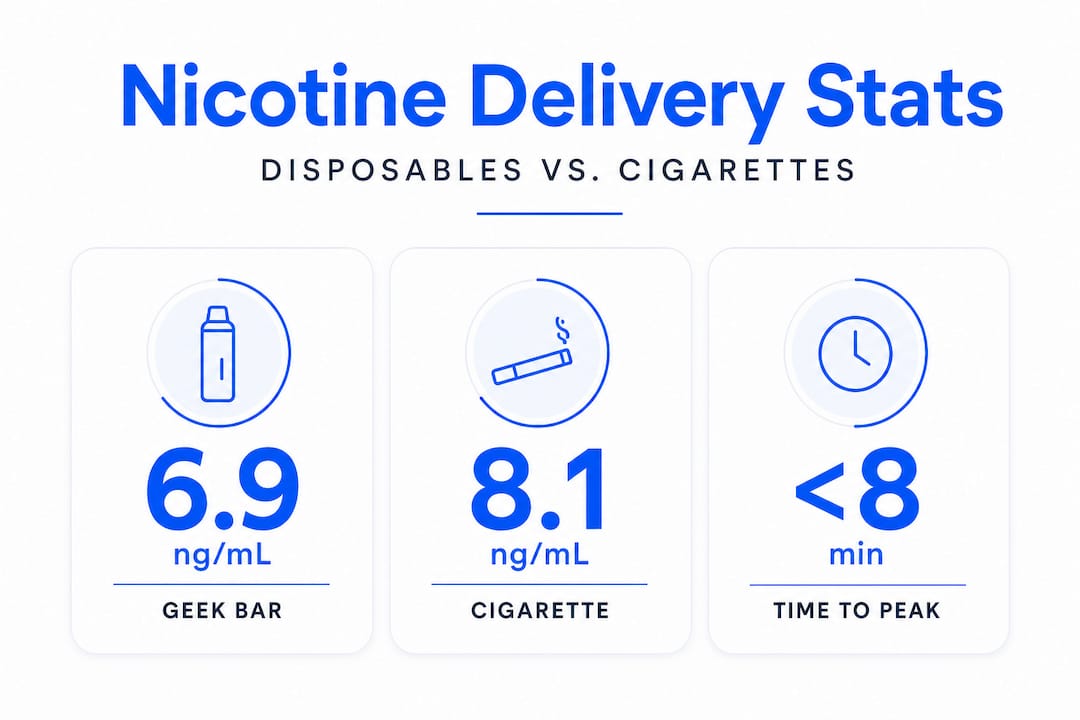
Empirical data makes the comparison clear. Published research shows that disposable vapes deliver a nicotine Cmax of 6.9 to 7.1 ng/mL, closely approaching cigarettes at 8.1 ng/mL, but with a faster initial uptake at a Tmax of 5 to 6 minutes compared to 8 minutes for cigarettes. Pod systems, by contrast, only reach a Cmax of around 3.1 ng/mL, which is less than half the nicotine delivery of a disposable.
That gap is why so many pod users feel unsatisfied. They’re getting significantly less nicotine per session.
Here’s how the three formats compare side by side:
| Device type | Nicotine Cmax (ng/mL) | Time to peak (Tmax) |
|---|---|---|
| Cigarette | 8.1 | ~8 minutes |
| Disposable vape | 6.9 to 7.1 | 5 to 6 minutes |
| Pod system | 3.1 | 10 to 15 minutes |
The practical implications of this data are significant. Disposables don’t just deliver comparable nicotine to cigarettes. They do it faster. That speed, combined with the smooth throat hit from nicotine salts, creates a very satisfying experience. But it also means you can reach your nicotine intake quickly without realizing it, especially if you’re puffing casually throughout the day.
Looking at disposable vape benefits for adult smokers is where the data starts to make real sense. The faster Tmax means cravings are addressed sooner, which reduces the urge to chain-puff or reach for a cigarette.
Here’s how to manage your usage strategically:
- Set a daily puff limit based on your previous cigarette consumption. One cigarette equals roughly 8 to 10 puffs on a typical disposable.
- Wait 10 minutes after a session before deciding if you need more. Nicotine continues to absorb after your last puff.
- Track device usage by noting when you open a new device and monitoring how quickly you exhaust it.
- Start lower if you’re new to disposables, especially if you’re switching from a pod system with lower nicotine output.
Pro Tip: If you’re transitioning from cigarettes, choose a 20mg/mL Geek Bar first. Starting at 50mg/mL when your tolerance is calibrated to cigarettes can feel overwhelming and may accelerate dependency rather than reduce it.
Risks, edge cases, and zero-nicotine options
Understanding strengths and speed is only part of the picture. The other side involves real risks that responsible use requires you to know.
The smoothness of nicotine salt delivery is genuinely one of its main selling points, but it creates a behavioral risk. Because the throat hit is minimal and the experience is pleasant at high concentrations, users often consume more without feeling the usual warning signals. According to Cleveland Clinic health data, higher nicotine salt concentrations in disposables increase addiction risk due to smooth delivery encouraging overuse, and zero-nicotine options exist but may carry trace contamination.
The contamination issue with zero-nic products is worth taking seriously. Shared manufacturing lines and equipment can introduce trace amounts of nicotine into products labeled as nicotine-free. If you’re using zero-nic disposables to step down or avoid nicotine entirely, understand that “zero-nicotine” on the label doesn’t always mean zero in the product.
Key risks to be aware of:
- Overuse due to smooth delivery: The absence of harshness removes a natural signal to stop
- Accidental exposure in households: High-concentration salt nic liquids are especially dangerous if ingested or touched by children
- Youth dependency: Smooth, flavorful disposables are more approachable for younger users, raising serious addiction concerns
- Trace nicotine in zero-nic products: Manufacturing cross-contamination is a documented issue
- No dosage control: Unlike refillable systems, you can’t lower the nicotine concentration in a disposable once it’s in your hand
“The smooth delivery of nicotine salts removes many of the sensory cues that traditionally signal overconsumption. Users should treat the device’s puff count, not the sensation, as their usage guide.”
Responsible access to vape products starts at purchase. Our resources on age verification for vapes explain the legal framework protecting minors, and our guide on childproof vape safety covers practical steps for preventing accidental exposure at home.
Pro Tip: Store your disposables out of reach of children and pets. Nicotine at 50mg/mL concentration is acutely toxic in small quantities. Even a partially used device poses a real hazard if left accessible.
Vaping for harm reduction and the debate on addiction
With risks in mind, it’s important to also examine the broader health debate. Do high-nicotine disposables support harm reduction, or do they create new problems?
The evidence here is genuinely split, and any honest discussion needs to hold both sides at the same time.
On the harm reduction side, the argument is strong. Vapes do not produce combustion, meaning the thousands of toxins and carcinogens created by burning tobacco are absent. Adults who switch completely from cigarettes to disposable vapes are exposed to significantly fewer harmful compounds. PubMed research confirms that while vapes deliver less total nicotine than cigarettes with fewer toxins, supporting a harm reduction argument, disposables’ high nicotine content and broad appeal raise legitimate youth addiction concerns, even though they remain effective tools for adult switching.
The youth concern is the central tension. Disposables are attractive precisely because they’re smooth, flavorful, easy to use, and discreet. Those same qualities that make them accessible for adult smokers make them appealing to young people who have never smoked at all, creating a new population of nicotine-dependent users rather than reducing harm in an existing one.
Major arguments in the harm reduction debate:
- For adult smokers: Disposables provide cigarette-comparable nicotine with a fraction of the toxins, supporting complete switching
- Against broad accessibility: Youth exposure creates addiction without prior tobacco use, negating population-level harm reduction
- For behavioral replacement: The physical act of vaping mimics smoking, which helps adult smokers manage habitual triggers
- Against high concentration: 50mg/mL products increase dependency risk faster than lower-dose alternatives
- For product standardization: Regulated disposables like Geek Bar are manufactured to consistent standards, unlike black-market alternatives
- Against environmental impact: Single-use plastics and batteries in disposables create significant waste concerns
Our overview of disposable vapes and harm reduction covers these tradeoffs in plain terms, and if sustainability matters to you, our piece on sustainable vaping choices addresses the environmental side of the equation.
An expert perspective: What most vape users miss about nicotine in disposables
Most vaping guides stop at explaining formulations and nicotine levels. What they rarely address is the behavioral layer sitting on top of the science.
Here’s the uncomfortable truth: the very features that make disposable vapes like Geek Bar satisfying are the same features that make self-monitoring harder. Smooth delivery, fast absorption, no throat hit, and a consistent flavor profile remove nearly every signal that traditionally helped users pace themselves. With cigarettes, the harshness, the smell, the visible product being consumed, and the physical act of lighting up all create natural checkpoints. Disposables eliminate most of those checkpoints.
That doesn’t make disposables bad products. It makes them products that require a different kind of user awareness. The data on Tmax at 5 to 6 minutes means your bloodstream is responding faster than you consciously register. You may feel satisfied before you’ve mentally “finished” your session, which often leads to picking the device back up moments later out of habit, not actual craving.
The guides most users read focus on which nicotine strength to choose or how long a device lasts. What they miss is that the speed of delivery and the smoothness of the experience require you to build your own behavioral guardrails that the product itself won’t provide. Set puff limits. Track your usage by device per week, not per day. If you’re using disposables as part of a quit or step-down strategy, pair them with a clear reduction schedule.
The real-world disposable vape guide we’ve put together addresses practical usage frameworks, not just specifications. Use it as a planning tool, not just a reference.
The marketing around disposables focuses heavily on flavor, convenience, and experience. Your job as an informed user is to add the one thing marketing never will: a personal usage framework that serves your actual goals.
Explore disposable vapes for your needs
You now have a factual, complete picture of how nicotine operates in disposable vapes, from formulation to absorption to risk. That knowledge puts you in a better position to choose the right product and use it responsibly.

At Cloud District, we carry a full range of disposable vapes including Geek Bar, across multiple nicotine strengths so you can match your choice to your actual needs. Whether you’re stepping down from cigarettes, managing consumption, or exploring zero-nic alternatives, the selection is available to browse and pick up locally. Every purchase earns you Cloudz rewards, and our platform is built for fast, straightforward access. Start by exploring our full list of vape brands to find the right fit.
Frequently asked questions
What makes nicotine salts in disposables different from regular vape juice?
Nicotine salts are more stable, allow higher concentrations (20 to 50mg/mL), and provide smoother hits with faster absorption than freebase nicotine, as confirmed by comparative formulation data. The result is a more satisfying experience at concentrations that would be too harsh with standard freebase formulas.
Is nicotine delivery from disposable vapes as strong as from cigarettes?
Disposable vapes deliver nicotine levels comparable to cigarettes, but absorption actually happens faster. Research data shows disposables reach peak nicotine concentration in 5 to 6 minutes versus 8 minutes for cigarettes, with similar Cmax levels.
What are the risks of using high nicotine disposables?
High nicotine levels combined with smooth delivery can increase addiction risk and encourage overuse, particularly in younger users. Cleveland Clinic notes that the smooth experience removes natural overconsumption signals, making self-monitoring essential.
Are zero-nicotine disposable vapes truly nicotine-free?
Zero-nic vapes are designed to avoid nicotine but may contain trace amounts due to manufacturing cross-contamination on shared production lines. Health guidance recommends caution for users who need to avoid all nicotine exposure.
Do disposable vapes help people quit smoking?
High-nicotine disposables can be effective tools for adult smokers switching away from cigarettes due to comparable nicotine delivery with fewer toxins. However, published research notes that they also carry addiction risks, especially for youth, and should be used with a clear reduction plan rather than as an open-ended replacement.