What Is a Cloud Chaser Vape? A Beginner's Guide
What Is a Cloud Chaser Vape? A Beginner’s Guide
A cloud chaser vape is a device and technique designed specifically to produce massive, dense vapor clouds through sub-ohm coils, high-VG e-liquids, and wide-open airflow using direct-to-lung (DTL) inhalation. Cloud chasing is a recognized style within the vaping community, distinct from standard mouth-to-lung vaping in both hardware and intent. Whether you are new to vaping or looking to understand what separates a cloud chaser setup from a regular device, the answer comes down to three core variables: coil resistance, e-liquid composition, and airflow design. Cloud District has put together this guide to cover everything from technical specs to beginner tips and health considerations.
What is a cloud chaser vape and how does it work?
A cloud chaser vape works by combining low-resistance coils, high-wattage output, and maximum airflow to vaporize large amounts of e-liquid with every inhale. The result is a thick, voluminous plume of vapor that defines the cloud chasing style. Understanding the hardware behind this output is the fastest way to know whether a device qualifies as a true cloud chaser setup.
Sub-ohm coils: the core of vapor production
Sub-ohm coils rated below 1.0Ω are the defining feature of any cloud chaser device. Lower resistance means more current flows through the coil at a given voltage, which generates more heat and vaporizes e-liquid faster and in greater volume. Most cloud chasing setups use coils in the 0.1Ω to 0.5Ω range, paired with box mods capable of firing at 60 to 200 watts. The higher the wattage, the more vapor the coil produces per draw.
Airflow and wattage control
Adjustable airflow rings are standard on cloud chaser tanks and rebuildable dripping atomizers (RDAs). Wide-open airflow serves two purposes: it cools the coil to prevent overheating, and it reduces draw resistance so you can pull large volumes of air and vapor directly into your lungs. Wattage control matters because firing a sub-ohm coil at too low a wattage produces thin, unsatisfying vapor, while too high a wattage burns the coil and the e-liquid. Finding the sweet spot for your specific coil resistance is part of the learning curve. You can explore vape coil types in detail to understand how resistance affects performance.
E-liquid: why VG ratio matters
High-VG e-liquids produce thicker vapor than high-PG formulas, making them the standard choice for cloud chasing. Vegetable glycerin (VG) is a denser, more viscous liquid that creates the large, billowing clouds associated with the style. Most cloud chasers use e-liquids with a VG/PG ratio of 70/30 or higher, with many preferring 80/20 or even max-VG blends. The trade-off is that high-VG liquids carry less flavor intensity than PG-heavy formulas, a compromise most cloud chasers accept willingly.
Pro Tip: Start with a 70/30 VG/PG ratio before moving to max-VG blends. The slightly higher PG content improves wicking speed in most coils, reducing the risk of dry hits while you dial in your wattage settings.
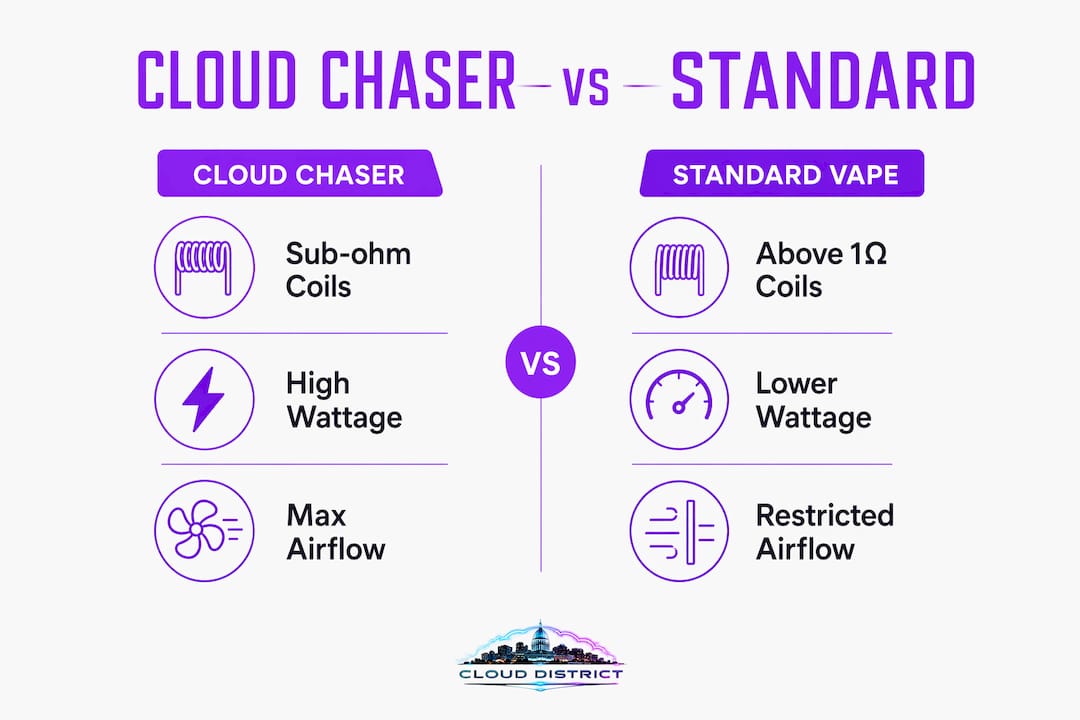
| Feature | Cloud chaser setup | Standard vape setup |
|---|---|---|
| Coil resistance | Below 1.0Ω (sub-ohm) | 1.0Ω or above |
| Airflow | Wide open, minimal restriction | Restricted, tighter draw |
| E-liquid VG ratio | 70/30 to max-VG | 50/50 or higher PG |
| Inhalation style | Direct-to-lung (DTL) | Mouth-to-lung (MTL) |
| Wattage range | 60W to 200W+ | 10W to 30W |
How does cloud chasing differ from mouth-to-lung vaping?
Cloud chasing and mouth-to-lung (MTL) vaping are fundamentally different experiences, not just variations on the same technique. The distinction starts with how you inhale and extends to every piece of hardware and e-liquid choice you make.
The key differences between cloud chasing and MTL vaping include:
- Inhalation method. DTL vaping means pulling vapor directly into your lungs in one continuous draw, similar to breathing deeply. MTL vaping mimics the draw of a cigarette: vapor collects in the mouth first, then gets inhaled into the lungs. DTL produces far more vapor per draw.
- Vapor density and cloud size. Cloud chasers prioritize visual plume experience over flavor nuance, using sub-ohm hardware and high-VG liquids to maximize output. MTL setups prioritize flavor concentration and a tighter, more cigarette-like draw.
- Nicotine strength. Cloud chasing setups typically use 3mg to 6mg nicotine concentrations. MTL devices often use 12mg to 20mg, or nicotine salt formulas at 25mg to 50mg. Because cloud chasing delivers more vapor per puff, lower nicotine concentrations still deliver a satisfying dose.
- Device complexity. Cloud chaser devices, including regulated box mods and RDAs, require more user knowledge. MTL devices like pod systems and pen-style vapes are simpler, more portable, and require less maintenance.
- User goals. MTL vaping suits those transitioning from cigarettes or preferring discreet use. Cloud chasing suits those drawn to the performance, hobby, and community aspects of vaping.
The choice between the two styles is not about which is better. It is about what you want from the experience.
What are the health considerations for cloud chasing?
Cloud chasing produces significantly more aerosol per session than standard vaping, which raises specific health considerations for both the user and people nearby. These are not hypothetical concerns. Research published in 2026 confirms measurable effects from secondhand aerosol exposure.
Secondhand e-cigarette aerosol causes respiratory symptoms including airway irritation, bronchitic symptoms, and increased airway resistance. These effects are documented in controlled studies, not just observational reports. The volume of aerosol produced during cloud chasing sessions amplifies this risk compared to low-output vaping.
“Exposure to secondhand vapor for even 30 minutes can cause immediate throat and airway irritation, airway resistance increase, and measurable lung function changes.” — Effects of secondhand exposure to e-cigarette aerosol on lung health
Cloud chasing increases bystander exposure in shared indoor spaces, making it a public health concern beyond the individual user. Children, elderly individuals, and people with asthma or respiratory conditions face the greatest risk from passive exposure. This is why cloud chasing is widely considered inappropriate in public spaces, restaurants, or any enclosed area with non-consenting bystanders.
Although secondhand vaping risk is generally lower than tobacco smoke, the involuntary nature of passive exposure makes it a growing concern for regulators and public health researchers. The responsible position is clear: cloud chasing belongs in private spaces or designated vaping areas where others are not affected. Understanding counterfeit vape risks is also part of responsible vaping, since unregulated devices and e-liquids carry additional unknowns.
How to get started with cloud chasing vaping
Getting into cloud chasing does not require expert-level knowledge from day one. It requires the right hardware, the right e-liquid, and a basic understanding of technique. Here is a practical starting point for beginners.
- Choose a regulated box mod. A regulated mod with variable wattage control is the safest starting point. Devices like the SMOK Morph 3 or GeekVape Aegis series offer wattage ranges up to 230W with built-in safety protections. Avoid unregulated mechanical mods until you fully understand Ohm’s law and battery safety.
- Select a sub-ohm tank or RDA. Sub-ohm tanks like the Freemax Mesh Pro are beginner-friendly because they use pre-built coils. RDAs offer more customization but require you to build and wick your own coils. Start with a tank, then move to an RDA once you are comfortable.
- Use a 70/30 or higher VG e-liquid. Pick a flavor you enjoy in a 70/30 or 80/20 VG/PG blend at 3mg to 6mg nicotine. Max-VG liquids are ideal for large clouds but require coils with good wicking capacity to avoid dry hits.
- Practice DTL breathing technique. Open the airflow ring fully and take a slow, steady draw directly into your lungs without holding vapor in your mouth first. Exhale slowly and steadily to maximize cloud size. Rushed or shallow draws produce thin, unsatisfying output.
- Avoid coil overheating. Wide airflow cools coils and prevents overheating during extended sessions. Chain vaping without adequate airflow is the most common cause of coil burnout for beginners. Allow a few seconds between draws when starting out.
Cloud chasing has a genuine community culture built around competitions, cloud contests, and online forums where enthusiasts share builds and techniques. Platforms like Reddit’s r/Vaping and dedicated Facebook groups are active spaces for beginners to ask questions and get feedback on their setups. You can also browse vape customization guides to understand how to tailor your device for maximum performance.
Pro Tip: Before your first cloud chasing session, prime your coil by dripping a few drops of e-liquid directly onto the cotton wick and letting it sit for five minutes. This prevents dry hits and extends coil life significantly.
Key takeaways
Cloud chasing requires sub-ohm coils, high-VG e-liquids, wide-open airflow, and direct-to-lung technique to produce large, dense vapor clouds responsibly.
| Point | Details |
|---|---|
| Sub-ohm coils are non-negotiable | Coils below 1.0Ω are required to generate the heat and vapor volume cloud chasing demands. |
| VG ratio determines cloud size | Use a minimum 70/30 VG/PG blend; higher VG produces thicker clouds with some flavor trade-off. |
| DTL technique separates styles | Direct-to-lung inhalation is what distinguishes cloud chasing from standard mouth-to-lung vaping. |
| Secondhand aerosol carries real risk | Even 30 minutes of passive exposure can cause measurable airway irritation and lung function changes. |
| Beginners should start with regulated mods | Variable wattage box mods with built-in safety protections are the safest entry point for new cloud chasers. |
Why cloud chasing taught me more about vaping than anything else
I have spent years watching cloud chasing evolve from a niche competition hobby into a mainstream vaping style, and the thing that still surprises me is how many people underestimate the technical knowledge it requires. This is not just about blowing big clouds for show. Getting a cloud chaser setup dialed in correctly means understanding coil resistance, battery amp limits, wicking technique, and e-liquid chemistry simultaneously.
What I find most underappreciated is the health responsibility side of it. The research on secondhand aerosol is clear enough that I think every cloud chaser should take it seriously, not as a reason to quit, but as a reason to be deliberate about where and when they vape. Producing a two-foot cloud in a crowded bar is not a flex. It is inconsiderate, and it gives the entire vaping community a bad reputation.
The technology has genuinely improved. Modern regulated mods with temperature control and wattage curves have made it far easier to get consistent performance without burning coils or overheating batteries. If you are starting out, you are entering the hobby at the best possible time in terms of device quality and available information. Use both wisely.
— Justin
Explore cloud chaser devices at Cloud District
Cloud District carries a curated selection of devices and e-liquids suited for cloud production, from popular disposable options to high-output hardware.
If you want serious vapor output without building a complex mod setup, the Pulse X 2 Blue Razz Bull and Pulse Strawberry Kiwi Thermal Edition deliver rich, dense clouds in a ready-to-use format. For those ready to explore the full range of brands and devices, Cloud District’s product lineup includes top-tier options across every vaping style. Every purchase earns Cloudz rewards, and the platform is built for fast, convenient local pickup.
FAQ
What does “cloud chaser” mean in vaping?
A cloud chaser is a vaper who prioritizes producing large, dense vapor clouds over flavor intensity or discreet use. The style uses sub-ohm coils, high-VG e-liquids, and direct-to-lung inhalation to maximize vapor output.
What nicotine strength should cloud chasers use?
Cloud chasing setups work best with 3mg to 6mg nicotine concentrations. Because high vapor volume delivers nicotine efficiently per draw, lower concentrations provide a satisfying experience without excessive throat hit.
Is cloud chasing safe around other people?
Cloud chasing in shared spaces carries documented risks for bystanders. Research confirms that 30 minutes of secondhand aerosol exposure can cause airway irritation and measurable lung function changes, making cloud chasing unsuitable in public or enclosed spaces with non-consenting individuals.
What is the best device for a beginner cloud chaser?
A regulated box mod paired with a sub-ohm tank is the recommended starting point. Devices with variable wattage control and built-in safety protections, such as the GeekVape Aegis series, allow beginners to learn coil and wattage management without the risks of unregulated mechanical mods.
Does cloud chasing reduce flavor quality?
High-VG e-liquids used in cloud chasing produce thicker vapor but deliver less flavor intensity than PG-heavy formulas. Cloud chasers generally accept this trade-off, prioritizing vapor volume and visual output over flavor nuance.