What Is a Smart Vape? Features, Benefits, and Risks

What Is a Smart Vape? Features, Benefits, and Risks
Smart vapes are not just upgraded versions of traditional e-cigarettes. They are vaping devices built around microprocessor technology that gives them the ability to monitor, adjust, and respond in real time. If you have been wondering what is a smart vape and how it actually differs from the basic disposable or box mod you already know, the answer goes deeper than a touchscreen or a Bluetooth connection. This article breaks down the technology behind these devices, what makes them genuinely different, and what you need to know before forming an opinion on them.
Table of Contents
- Key Takeaways
- How smart vape technology actually works
- Features that separate smart vapes from traditional devices
- Benefits and risks of smart vaping devices
- Practical considerations before buying a smart vape
- My honest take on where smart vapes stand
- Explore smart and traditional vapes at Cloud District
- FAQ
Key Takeaways
| Point | Details |
|---|---|
| Smart chip is the core | A microprocessor inside the device controls power, temperature, and safety functions thousands of times per second. |
| Safety is a real advantage | Automatic shutoffs, overheat protection, and low-voltage cutoffs reduce the risk of device malfunction. |
| Gamification raises concern | Features like virtual pets and leaderboards are designed to increase puff frequency, particularly among younger users. |
| Performance is measurably better | Smart Prime technology cuts coil saturation time to about 60 seconds, compared to several minutes on traditional devices. |
| Counterfeits are a serious risk | Devices without verified chips lack all safety protections, making source verification a practical priority. |
How smart vape technology actually works
The term “smart vape” refers to any vaping device that contains a dedicated microprocessor chip responsible for managing the device’s core functions. This is not cosmetic. The chip is the operational center of the device, and it changes what the device can do compared to a traditional coil-and-battery setup.
Traditional vaping devices use open-loop systems. You press the button, power flows to the coil, and the coil heats. There is no feedback, no adjustment, and no correction if something goes wrong. Smart vapes use closed-loop control instead. The chip continuously reads coil resistance, battery voltage, and temperature, then adjusts the power output accordingly. Closed-loop systems differentiate smart chips from traditional open-loop devices in a fundamental way.
Here is what the chip actually manages:
- Power regulation: The chip adjusts voltage and current flow in real time to maintain consistent vapor output even as the battery drains.
- Temperature inference: Smart chips use coil resistance changes to infer temperature, enabling accurate control without a dedicated heat sensor.
- Safety monitoring: The chip checks for short circuits, abnormal resistance, and dangerous battery conditions. It performs these checks thousands of times per second.
- Battery efficiency: Modern smart chips in 2026 devices deliver about 30% lower power consumption compared to traditional devices.
One of the most practical examples of smart chip innovation is Vaporesso’s Smart Prime technology, found in devices like the XROS 6. The system uses predictive impedance modeling to pre-saturate the coil before the first draw. The result: coil saturation time drops from several minutes to approximately 60 seconds. That matters because dry hits on an unsaturated coil degrade the coil faster and produce a noticeably worse experience.
Pro Tip: If you are evaluating a smart vape, look for devices that publish their chip specifications. A named chip with documented safety protocols is a credible signal. A device that only claims to be “smart” without specifics is likely marketing language.
Features that separate smart vapes from traditional devices
The technology difference is real, but the feature set is where smart vapes become genuinely distinct products in the market.
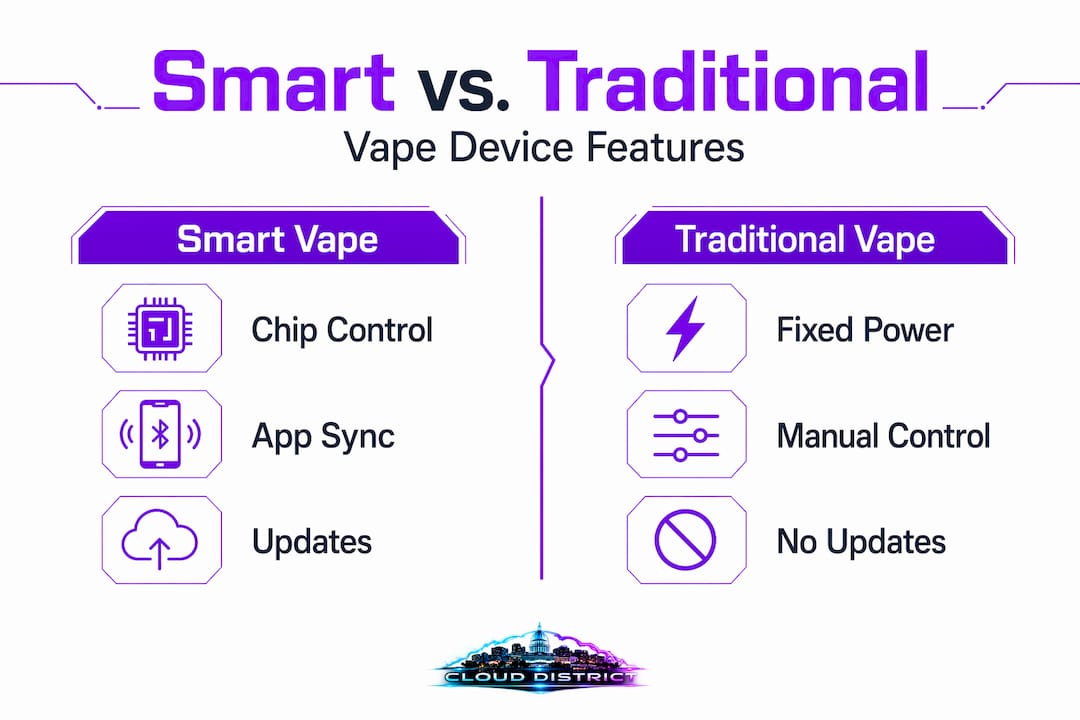
| Feature | Smart Vape | Traditional Vape |
|---|---|---|
| Power management | Closed-loop, chip-controlled | Fixed or manual |
| Safety shutoffs | Automatic, multi-layered | Minimal or none |
| Coil saturation | Predictive, reduced wait time | Manual priming required |
| Connectivity | Bluetooth, app integration | None |
| Display | Touchscreen or digital | Basic or none |
| Firmware updates | Yes, over-the-air capable | No |
Beyond the performance specs, smart vaping devices have incorporated features that look more like smartphone capabilities than traditional vaping hardware. Bluetooth connectivity, touchscreens, and app integration are now standard on many mid-to-premium devices. Some allow users to customize wallpapers, track puff counts, and receive social media notifications directly on the device display.

There is also a category of features designed around engagement rather than performance. Gamification elements like virtual pets and leaderboards have been integrated into certain smart vape products. The virtual pet feature, for example, rewards puff frequency by evolving the on-screen character. This type of design decision has drawn significant criticism from public health researchers, and rightly so.
On the positive side, over-the-air firmware updates mean manufacturers can push safety patches and feature improvements without requiring a hardware replacement. This is a meaningful advantage over traditional devices, which are static once manufactured. The rechargeable and reusable nature of most smart vape platforms also reduces single-use waste compared to standard disposables.
Benefits and risks of smart vaping devices
The benefits of smart vapes are real and measurable. The risks are equally real. A clear-eyed view requires addressing both without dismissing either.
The genuine benefits:
- Automatic safety shutdowns protect against overheating, overcharging, and coil failure.
- Puff counters and usage tracking give users data they can act on.
- Consistent vapor production through chip-regulated power delivery improves the experience compared to voltage-drop degradation on traditional devices.
- Temperature control options allow users to set limits that reduce the production of certain byproducts associated with overheating.
The documented risks:
The same technology that enables safety features also enables psychological manipulation. Gaming mechanics accelerate nicotine addiction among younger users by exploiting familiar reward loops. Earning points, leveling up a virtual pet, or competing on a leaderboard creates compulsive use patterns that go beyond simple nicotine dependence.
“Smart vapes are designed to be compelling in ways that have nothing to do with nicotine delivery. The technology is real. So is the intention behind some of these features.” — Public health perspective on smart vape marketing
Affordability compounds the concern. Devices priced around $15 to $20 are accessible to teenagers despite legal purchase restrictions. The combination of low cost, gamified interfaces, and fruity flavor profiles creates a product profile that health advocates argue is deliberately youth-targeted.
From a regulatory standpoint, smart chip features like puff counting and firmware updates give manufacturers detailed behavioral data on users. How that data is collected, stored, and used remains largely outside current regulatory frameworks. This is an open question that the industry has not answered clearly.
Practical considerations before buying a smart vape
If you are 21 or older and considering a smart vaping device, understanding what to look for protects both your safety and your money.
-
Verify the chip is documented. Any reputable device will name its chip and publish its safety certifications. A device with no chip documentation is either a basic device being marketed as smart, or a counterfeit. Counterfeit vapes lack the safety features that justify the smart vape designation entirely.
-
Check battery capacity against your use pattern. Smart chips consume power even when the device is not actively in use. Pre-saturation algorithms require continuous low-power monitoring, meaning the device is never fully inactive. A 500mAh battery in a smart device drains faster than the same capacity in a passive device.
-
Understand what the app actually does. Some companion apps offer genuine utility such as usage tracking, power adjustment, and firmware updates. Others are primarily data collection vehicles. Read the permissions before connecting.
-
Set your usage parameters deliberately. Most smart vapes allow you to set puff limits, session timers, and power levels. Use these features. They exist precisely to give you control that traditional devices cannot offer.
-
Purchase from verified retailers only. Smart vape technology is only as good as the hardware it runs on. Unverified sellers frequently stock counterfeit devices that mimic the external appearance of smart vapes without any of the chip-based safety systems. The Cloud District blog covers how to identify legitimate products and what red flags to watch for.
Pro Tip: When charging a smart vape for the first time, let it reach full charge before first use. The chip calibrates battery voltage thresholds during this cycle, which affects how accurately it reports remaining battery life throughout the device’s lifespan.
My honest take on where smart vapes stand
I have spent years watching technology get layered onto consumer products as marketing rather than meaningful improvement. Smart vapes are not entirely that story, but they are not entirely clean of it either.
The chip technology is genuinely useful. I have tested devices with closed-loop power management against basic regulated mods, and the consistency difference is real. Temperature stability, coil longevity, and draw consistency are all measurably better. When I pick up a device that uses something like Smart Prime, the reduction in dry hits alone justifies the label.
What concerns me is the feature creep that has nothing to do with performance. Virtual pets and social leaderboards are not safety features. They are engagement mechanics borrowed from mobile gaming, and they work the same way here. They increase puff frequency. That is not a coincidence. It is a design decision.
My view is that the technology itself represents a legitimate improvement over passive vaping hardware. The problem is that some manufacturers have used that technology as a Trojan horse for features that serve no purpose except to increase consumption. Informed adult consumers can separate those two things. Most people buying a $15 device with a cartoon character on the screen are not engaging in that kind of critical evaluation.
The industry needs clearer standards for what qualifies as a “smart” device, and regulators need frameworks that address behavioral data collection. Until that exists, the label “smart vape” covers everything from genuinely advanced hardware to gamified nicotine dispensers with a chip sticker on the side.
— Justin
Explore smart and traditional vapes at Cloud District

Cloud District carries a curated selection of vaping products for adults 21 and older, including devices that use the kind of advanced chip technology covered in this article. Whether you are looking for a performance-focused device or a familiar disposable from a trusted brand, the Cloud District platform lets you browse, order, and pick up locally without the guesswork. The built-in Cloudz rewards program means you earn on every purchase. Explore the full product catalog to see current inventory, or check out specific options like the Pulse Strawberry Kiwi Thermal Edition if thermal management technology is what you are after. Exclusive deals and top brands are available to verified adult customers.
FAQ
What is a smart vape exactly?
A smart vape is a vaping device that contains a microprocessor chip responsible for regulating power output, temperature, and safety functions in real time. Unlike traditional vapes, smart vapes use closed-loop control systems that continuously adjust performance based on coil resistance, battery voltage, and temperature readings.
How does a smart vape work differently from a regular vape?
Traditional vapes deliver a fixed voltage to the coil with no feedback or correction. Smart vapes use a chip that monitors device conditions thousands of times per second and adjusts power output to maintain consistent performance and prevent unsafe conditions like overheating or short circuits.
Are smart vapes safer than traditional vaping devices?
Smart chips add multiple layers of protection including automatic shutdowns, overheat cutoffs, and low-voltage protection that traditional devices lack. However, safety depends entirely on whether the device contains a genuine, documented chip. Counterfeit devices that look like smart vapes offer none of these protections.
Why are smart vapes a concern for youth safety?
Some smart vapes include gamification features like virtual pets and leaderboards that reward puff frequency, which experts link to accelerated nicotine addiction among younger users. Devices priced between $15 and $20 are accessible despite legal age restrictions, making enforcement difficult.
What features should I look for in a smart vape?
Look for documented chip specifications, firmware update capability, automatic safety shutoffs, battery management features, and a companion app with meaningful utility rather than just data collection. Purchase only from verified retailers to avoid counterfeit hardware that lacks genuine chip functionality.