What Is Vape Performance? Factors and Tips for 2026
What Is Vape Performance? Factors and Tips for 2026
Vape performance is defined as the measure of how consistently a device delivers vapor output, flavor accuracy, and reliable firing across its lifespan. Power delivery, airflow, and e-liquid heating efficiency are the three pillars that determine whether a device performs well or falls short. Understanding vape performance factors separates vapers who get the most from their devices from those who replace them prematurely. Devices like the VOOPOO ARGUS G4 and the VOOPOO NAVI x Cyph Kit represent the current standard for what high-performance hardware looks like in practice. This article breaks down every variable that shapes your vaping experience, from coil resistance to battery voltage, so you can make informed decisions about your setup.
What is vape performance and how does power affect it?
Vape performance, in practical terms, means how well your device converts electrical energy into satisfying vapor and flavor on every single puff. The coil sits at the center of this process. When the battery sends power to the coil, the coil heats the e-liquid until it vaporizes. The wattage you select directly controls how hot the coil gets and how much vapor is produced per draw.
There is a specific range where power works most efficiently. Vapor output increases proportionally with power within what researchers call the Optimal Regime. Below this range, the coil underheats and produces thin, flavorless vapor. Above it, the coil overheats the e-liquid before it can wick properly, causing dry puffs and a burnt taste. This means more wattage is not always better. It means the right wattage for your coil and e-liquid combination is what matters.
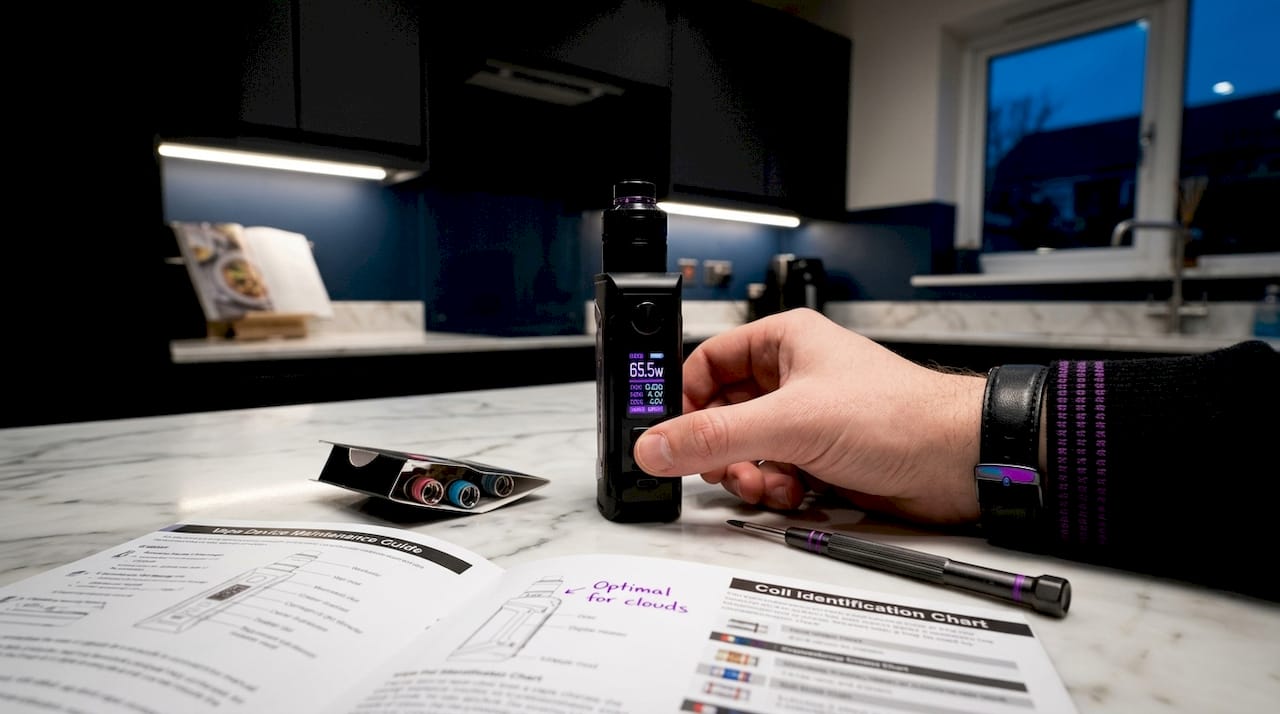
Coil resistance plays an equally direct role. Sub-ohm coils, those rated below 1.0 ohm, increase heat transfer and vapor production by roughly 30% compared to standard resistance coils at the same wattage. This is why sub-ohm tanks are popular among cloud-focused vapers. Higher resistance coils, typically 1.0 ohm and above, run at lower wattages and produce a tighter, more cigarette-like draw with concentrated flavor.
Pro Tip: Match your wattage to the coil’s rated range printed on the coil itself. Running a 0.6-ohm coil at 35 to 45 watts typically delivers the best balance of vapor density and flavor without burning the wick.
How airflow and e-liquid composition shape your experience
Airflow design is one of the most underappreciated vape performance factors. The amount of air passing over the coil during a draw changes both vapor density and flavor intensity in measurable ways. Restricted airflow creates a tighter draw, concentrates the vapor, and intensifies flavor. Open airflow dilutes the vapor with more air, producing larger clouds but a softer flavor profile.
The balance between airflow and e-liquid viscosity also determines how well the coil wicks. Here is how the key variables interact:
- VG/PG ratio: Higher vegetable glycerin (VG) content, typically 70% or above, produces thicker vapor and a smoother throat hit. High VG liquids work best with open airflow and lower resistance coils because the liquid is thicker and needs more heat to vaporize efficiently.
- PG content: Propylene glycol (PG) carries flavor compounds more effectively and delivers a stronger throat hit. Higher PG liquids, around 50/50 or 60/40 PG/VG, suit restricted airflow setups and higher resistance coils.
- Wicking efficiency: Thick VG liquids can starve a coil if the wicking ports are too small, leading to dry hits. Choosing an e-liquid matched to your coil’s wicking design prevents this.
- Vaping style: Mouth-to-lung (MTL) vapers draw vapor into the mouth first, then inhale. Direct-to-lung (DTL) vapers inhale directly. MTL suits restricted airflow and higher PG liquids. DTL suits open airflow and high VG blends.
Understanding vape terminology like MTL and DTL helps you select the right device and liquid combination from the start, rather than troubleshooting poor performance after the fact.
Why battery health determines long-term vape device efficiency
Battery condition is the variable most vapers ignore until performance noticeably drops. Lithium-ion batteries degrade over charge cycles, and as internal resistance builds, voltage drop reduces power reaching the coil. The result is weaker vapor and inconsistent flavor even when the battery indicator reads full. This phenomenon is called voltage sag, and it is one of the most common hidden causes of declining vape output.
High-quality 18650 cells reduce voltage sag by 0.2 to 0.5 volts under load compared to lower-grade alternatives. That difference is significant. A coil rated for 40 watts receiving only 35 watts due to voltage sag will underperform noticeably. The fix is not always a new device. Sometimes it is simply a better battery.
Maintenance extends battery performance and protects the coil simultaneously. Follow these steps to keep your device running at its best:
- Clean contact pins weekly. Residue and oxidation on battery contacts increase resistance, which compounds voltage drop. A cotton swab with isopropyl alcohol removes buildup in under a minute.
- Check threading regularly. Loose or dirty threading between the tank and mod creates additional resistance that reduces power delivery to the coil.
- Update firmware when available. Many regulated mods release firmware updates that improve power regulation accuracy and firing consistency.
- Avoid deep discharges. Draining a lithium-ion battery below 20% repeatedly accelerates internal resistance buildup and shortens overall lifespan.
Pro Tip: Measure your device’s actual output under load using a vape tester or ohmmeter. The idle voltage reading on your screen is not the same as the voltage your coil receives during a puff. Effective diagnostics require under-load measurement to catch hidden voltage drop.
How to identify and fix declining vape output
Performance decline rarely happens all at once. It builds gradually, and most vapers adapt to it without realizing the device is underperforming. Knowing the signs and causes lets you address problems before they ruin a coil or a session.
Common causes of reduced output include degraded coils, poor wicking from thick e-liquid, low battery charge, mismatched juice viscosity for the coil type, and dirty electrical contacts. Dry puffs result from exceeding efficient vaporization, where the coil overheats the liquid faster than the wick can resupply it. This is both a performance failure and a flavor failure simultaneously.
The signs to watch for are specific:
- Flavor becomes noticeably muted or develops a faint burnt undertone
- Vapor clouds shrink in density even at the same wattage setting
- The device fires inconsistently or takes longer to respond
- Battery runtime shortens between charges without a change in usage habits
- A gurgling sound during draws, which signals flooded wicking ports
Testing your device’s output is straightforward. Draw at your normal pace and note vapor thickness across five consecutive puffs. If density drops significantly by the third or fourth puff, wicking is the likely issue. If flavor is flat from the first puff, the coil is the problem.
Optimization follows a clear sequence: replace the coil, prime the new coil with three to five drops of e-liquid directly onto the cotton before installing, adjust airflow to match your e-liquid’s VG content, and use a steady, consistent draw speed. Erratic puffing behavior disrupts the wicking cycle and reduces aerosol quality. For vapers exploring device customization options, adjustable wattage and airflow controls give you the most direct control over output consistency.
Vape performance comparison: top devices in 2026
Real-world device performance brings all these variables together. The VOOPOO ARGUS G4 and VOOPOO NAVI x Cyph Kit represent two distinct approaches to high-performance vaping, each optimized for different priorities.
The ARGUS G4 demonstrated efficient wicking and strong flavor in both restricted direct-to-lung (RDL) and MTL modes during testing. Flavor degradation was only noticeable after 25 milliliters of dark or sweet e-liquid, and pods maintained consistent performance beyond 30 to 40 milliliters. This makes coil-liquid compatibility a measurable advantage. The NAVI x Cyph Kit takes a different approach, using a 1,500 mAh battery with an 81-minute charge time and a turbo mode that activates dual coils for increased vapor density. Normal mode conserves battery and delivers smoother hits. Multiple heating modes alter coil activation and heat transfer per puff, which means switching modes changes the entire performance profile, not just the wattage.
| Device | Battery | Key strength | Best for |
|---|---|---|---|
| VOOPOO ARGUS G4 | Integrated | Flavor longevity, efficient wicking | MTL and RDL vapers |
| VOOPOO ARGUS G4 Mini | Integrated | Compact form, maintained flavor | Portability-focused users |
| VOOPOO NAVI x Cyph Kit | 1,500 mAh | Turbo mode, long battery life | Cloud and power users |
| Geek Bar disposables | Integrated | Consistent output, no setup | Convenience-first vapers |
Puff count, recharge speed, and battery capacity are the three efficiency metrics that matter most when comparing devices. A device with a high puff count but slow recharge time may not suit daily heavy users. A compact device with fast USB-C charging may outperform a larger device in practical daily use even if its raw battery capacity is lower.
Key takeaways
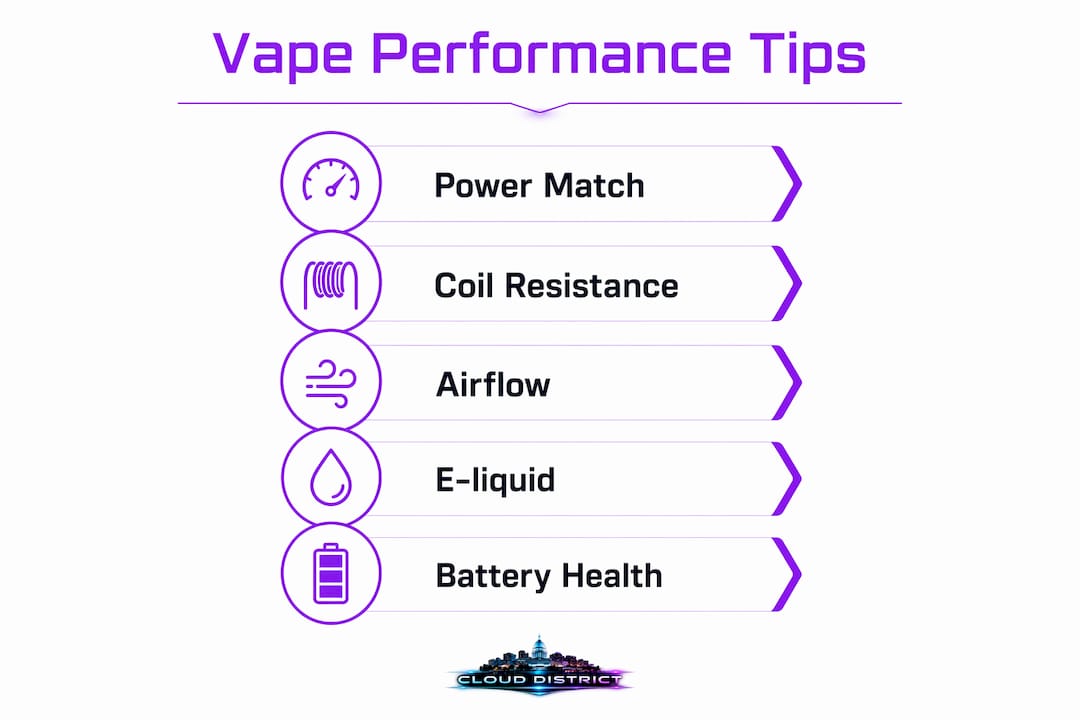
Vape performance is determined by the interaction of coil resistance, power delivery, airflow design, e-liquid composition, and battery health, and optimizing all five variables produces the most consistent output.
| Point | Details |
|---|---|
| Power and coil resistance | Match wattage to coil rating; sub-ohm coils increase vapor output significantly at the right wattage. |
| Airflow and e-liquid pairing | Restricted airflow suits high PG liquids; open airflow suits high VG blends for maximum vapor. |
| Battery maintenance | Clean contacts weekly and avoid deep discharges to prevent voltage sag and weak hits. |
| Performance decline signs | Muted flavor, reduced vapor density, and inconsistent firing are early indicators of coil or battery issues. |
| Device selection | Battery capacity, recharge speed, and coil compatibility are the three metrics that define real-world efficiency. |
What I’ve learned from years of watching vapers troubleshoot performance
Most vapers I’ve observed focus almost entirely on the device itself when performance drops. They replace the mod, buy a new tank, or switch brands. The coil and the battery are almost always the actual problem, and they cost a fraction of a new device.
The single most common mistake is running a coil past its useful life because the performance decline is gradual enough to normalize. A coil that has processed 20 to 30 milliliters of sweet or dark e-liquid is almost certainly past its peak, even if it still fires. The flavor you think is normal may be 30% worse than what a fresh coil would deliver.
The second mistake is ignoring airflow when switching e-liquids. Vapers often change from a 50/50 liquid to a high VG blend without adjusting airflow, then blame the device when wicking slows and dry hits appear. The device is not the problem. The mismatch between liquid viscosity and airflow restriction is.
Battery care gets the least attention and causes the most long-term damage to vaping performance metrics. Charging to 100% and leaving the device plugged in, or running the battery to near zero repeatedly, both accelerate internal resistance buildup. Neither habit is catastrophic on its own. Over 200 to 300 cycles, the cumulative effect is a battery that sags noticeably under load and delivers inconsistent power to the coil.
If you want to choose the right vape from the start and avoid these issues, prioritize devices with regulated output, replaceable coils, and documented battery specs. The specs tell you what the device is designed to do. Your maintenance habits determine whether it actually does it.
— Justin
Find high-performance vapes at Cloud District
Cloud District stocks a curated selection of devices built for consistent output, including Geek Bar disposables, Pulse X, and a range of pod systems suited to every vaping style.

Whether you prioritize flavor longevity, battery efficiency, or cloud production, Cloud District’s full catalog covers every performance tier. The Pulse Strawberry Kiwi Thermal Edition delivers consistent flavor across its full puff count, making it a reliable benchmark for disposable performance. Every purchase earns Cloudz rewards, and local pickup keeps your next device within reach. Browse the full selection and find the device that matches your output requirements.
FAQ
What is vape performance defined as?
Vape performance is the quality and consistency of vapor output, flavor delivery, and reliable firing a device produces over time. Power delivery, airflow, and e-liquid heating efficiency are the primary factors that determine it.
What affects vape quality the most?
Coil condition and battery health are the two variables that most directly affect vape quality in daily use. A degraded coil or a battery with high internal resistance both reduce vapor density and flavor accuracy regardless of device quality.
How do I improve vape performance at home?
Replace coils before flavor degrades noticeably, clean contact pins weekly with isopropyl alcohol, and match your e-liquid’s VG/PG ratio to your airflow setting. These three steps address the most common causes of reduced output.
What is voltage sag and why does it matter?
Voltage sag occurs when a battery’s internal resistance prevents full power from reaching the coil during a draw. High-quality 18650 cells reduce this sag by 0.2 to 0.5 volts, which translates directly to more consistent vapor production.
How do I compare vape devices by performance?
Use battery capacity, recharge time, puff count, and coil compatibility as your primary comparison metrics. Devices like the VOOPOO NAVI x Cyph Kit add mode-based performance options that change output profile, giving experienced vapers more control over their results.